
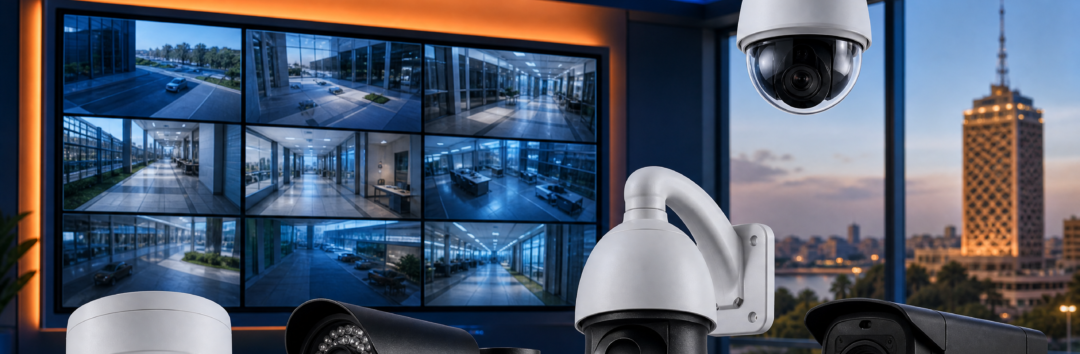
CCTV Camera Types
Dome, Bullet, PTZ, Fisheye, Thermal and ANPR — Which Camera Type Fits Your Project in Egypt?
Dome • Bullet • PTZ • Fisheye • Thermal • ANPR • IP Camera • CCTV
Today, CCTV Cameras (Closed-Circuit Television) are a key component of integrated security systems for companies, factories, hotels, hospitals and residential compounds. Before choosing a suitable model, remember that there are several different CCTV camera designs, each with different features, limitations and applications.
A common question is: should I choose a Dome or Bullet? When would I need a PTZ? Is a Thermal worth the cost? In this guide from AY Technology we compare the main CCTV camera types and explain how to match them to the needs of your project.
What Will You Learn in This Guide?
What Will You Learn in This Guide?
- – Common CCTV Camera Types: Dome, Bullet and Turret/Box
- – Motorized PTZ and Speed Dome Cameras
- – Fisheye and 360-Degree Cameras for Wide Areas
- – Thermal Cameras and Their Applications
- – License Plate Recognition Cameras (ANPR / LPR)
- – IP Cameras vs Analog vs HD-TVI
- – Choosing the Right Camera Type for Each Project Area
- – Connecting Camera Selection with Practical AY Technology Services
Why Does Camera Type Matter More Than Brand?
Before comparing models, start with one important principle: Camera housing and mounting style influence where a camera fits, while the sensor, lens and resolution affect image detail.. Even a premium camera can perform poorly when its design or mounting position does not match the application.
Practical example: a Bullet fixed-lens bullet camera can suit an industrial entrance, but may be too conspicuous for a hotel reception. Conversely, a Dome discreet indoor model may not have suitable weather protection for an exposed factory roof.
Common CCTV Camera Types: Dome, Bullet and Turret
Three common camera designs used in surveillance projects
- – Dome Camera: Rounded camera housing for indoor or outdoor use depending on model, frequently specified in offices and hotels.
- – Bullet Camera: Cylindrical camera style often selected for outdoor entrances, factories and perimeter surveillance.
- – Turret / Eyeball Camera: Open-face camera design without a glass dome, often reducing night-time IR reflections.
Dome Cameras: Discreet and Versatile
Camera Dome A dome camera uses a rounded enclosure that can provide a discreet appearance. Some enclosed models also offer additional vandal resistance.
Advantages:
- Discreet appearance suitable for offices, hotels and hospitals
- Vandal-resistant housings are available, including IK10-rated models
- The camera's pointing direction may be less obvious to passersby
- Indoor and outdoor versions are available
Limitations:
- Dome covers can create IR reflections at night if installation or maintenance is poor
- Weather resistance varies by the product's exact IP rating and installation
Recommended applications: Reception areas, open-plan offices, hotel corridors, indoor passages and lifts.
Bullet Cameras: Outdoor Monitoring
Camera Bullet An elongated camera enclosure commonly includes a sunshade that can help shield the lens from direct rain and sunlight. This design is a common choice for outdoor surveillance.
Advantages:
- IR night-vision distance varies by model and site conditions. Check the actual specifications
- Outdoor-rated models may offer IP67 or IP68 protection. Verify the manufacturer's rating
- Can often be manually repositioned when needed
- Pricing depends on the selected model and specification
Limitations:
- The visible housing can make the camera's viewing direction easier to identify
- Protruding wall installations can be more exposed to tampering
- The design may be less suitable for premium indoor spaces
Recommended applications: Factory entrances, facility perimeters, car parks, exterior roads and warehouses.
Turret Cameras (Eyeball): Open-Face Design
Camera Turret A turret camera has an exposed lens assembly without a dome cover. This can reduce reflections from the infrared illuminator and deliver clearer night-time images than a comparable covered dome in suitable conditions.
Advantages:
- Reduced risk of IR reflections with suitable installation
- Flexible installation and camera positioning
- Compact size and modern appearance
- Weather-resistant versions are available
Limitations:
- Vandal protection depends on the model and housing
- Exposed mounting positions may require additional protection
Recommended applications: Corridors, stairways, hotel floors and residential interiors.
Comparison Table: Dome vs Bullet vs Turret
| Criterion | Dome | Bullet | Turret |
|---|---|---|---|
| Housing design | Enclosed rounded dome | Cylindrical body with sunshade | Open-face rounded head |
| Typical application | Indoor / reception / hotels | Outdoor / entrances / factories | Indoor and outdoor |
| Vandal resistance | High on properly IK10-rated models | Medium | Low |
| Weather resistance | Good | Excellent on suitable IP67/IP68 models | Excellent |
| IR night performance | Good | Strong on long-range IR models | Good with reduced dome reflections |
| Security discretion | Viewing direction less obvious | Visible viewing direction | Viewing direction less obvious |
| Best suited to | Hotels and Offices | Industrial sites and outdoor areas | General-purpose use |
No single camera is the best choice for every location. A complete project may combine: Bullet for outdoor perimeters, andDome/Turret for indoor areas, andPTZ in wide areas. AY Technology applies this project-specific approach when designing CCTV systems.
Motorized PTZ and Speed Dome Cameras
PTZ Camera (Pan-Tilt-Zoom)
Camera PTZ A PTZ camera can pan horizontally, tilt vertically and use optical zoom. Some models, such as Speed Dome offer rapid pan movement and powerful optical zoom, depending on the manufacturer's specifications.
Advantages:
- A PTZ camera can inspect several areas in sequence
- Moving-object tracking may be available on supported models
- Optical zoom can capture distant detail when site conditions allow
- Programmable preset positions and patrol routes
Limitations:
- PTZ cameras generally cost more than comparable fixed cameras
- Operator training or careful preset configuration may be required
- Cannot continuously watch all directions simultaneously
Recommended applications: Large plazas, stadiums, industrial yards, entry points, hotels and airports.
PTZ cameras should complement fixed cameras, not replace them. A practical design principle is: use fixed cameras for continuous coverage and PTZ for active inspection or tracking. Avoid relying on PTZ alone for full-area surveillance.
Fisheye and 360-Degree Surveillance Cameras
Camera Fisheye Wide-angle panoramic cameras may cover a broad area when mounted at a suitable central point. Some specialized modelsMulti-Directional use multiple lenses within one enclosure to improve panoramic coverage and detail.
Advantages:
- Wide-area coverage with fewer devices, depending on pixel-density requirements
- De-warping can convert panoramic images into conventional viewing windows
- Useful in open banking halls, reception areas and large warehouses
Limitations:
- Pixel density in each direction may be lower than that of dedicated cameras
- A compatible NVR or VMS is needed for de-warping features
Recommended applications: Large lounges, reception halls and open warehouse areas.
Thermal Imaging CCTV Cameras
A thermal camera Thermal detects infrared heat patterns rather than recording ordinary visible-light images, capturing heat signatures emitted by objects. Thermal imaging can support detection in darkness or some difficult visibility conditions, depending on the equipment and environment.
Advantages:
- Can detect heat signatures in darkness
- May help in certain fog or smoke conditions, depending on severity
- Specialized thermal systems can detect targets at long distances
- Less dependent on visible backlighting
Limitations:
- Specialized cameras can be relatively expensive
- Thermal footage normally lacks natural color and conventional facial detail
Recommended applications: Perimeter monitoring around major infrastructure, industrial sites, ports and large facilities.
ANPR / LPR License Plate Recognition Cameras
Camera ANPR (Automatic Number Plate Recognition) ANPR cameras capture vehicle registration plates using suitable lenses, shutter speeds and illumination. Performance depends on placement, vehicle speed and plate format.
Advantages:
- Automatic plate capture at controlled vehicle entry points
- Allowlist and blocklist features where supported
- Potential integration with barrier gates for authorized entry
- Searchable event records and reports for security teams
Limitations:
- Correct camera angle, mounting height and calibration are essential
- High-speed plate recognition requires dedicated equipment and configuration
Recommended applications: Office and hotel car parks, residential compounds, factory entrances and paid garages.
CCTV Camera Types at a Glance
| Type | Field of view | Recommended application | Typical night range | Relative cost |
|---|---|---|---|---|
| Dome | Model-dependent viewing angle | Indoor spaces and receptions | Depends on specifications | Low |
| Bullet | Model-dependent viewing angle | Outdoor spaces and entrances | Depends on specifications | Low |
| Turret | Model-dependent viewing angle | General | Depends on specifications | Low |
| PTZ / Speed Dome | Motorized with optical zoom | Large open spaces | Model-dependent range | High |
| Fisheye | Wide panoramic coverage | Large halls | Model-dependent distance | Medium |
| Thermal | Detects heat signatures | Perimeters and borders | Thermal range depends on the sensor and lens, even at night | Very high |
| ANPR | Narrow viewing angle, depending on the lens | Vehicle entrances | Model- and site-dependent | Medium to high |
How to Choose the Right Camera Type for Each Area
A practical design approach for CCTV projects is to evaluate CCTV cameras:
Exterior perimeters and fences: cameras Bullet with appropriate IR range at corners, supported by ANPR at vehicle gates and a PTZ for active inspection of large yards. Higher-risk facilities may additionally require Thermal at sensitive perimeter points.
Indoor entrances and corridors: cameras Dome or Turret fixed cameras positioned to capture the required detail at each entrance, with Fisheye in larger lobbies.
Reception areas and premium offices: Dome Discreet ceiling-mounted Dome cameras or compact Turret models.
Warehouses and large spaces: A mix of Dome at perimeter corners + Fisheye at the center + PTZ for very large open areas.
Sensitive locations (cash desks and vaults): Fixed cameras with a suitable sensor and lens for the required scene detail, without depending on digital zoom.
AY Technology approaches CCTV projects as integrated systems rather than standalone cameras. Site assessment, camera placement, recording, storage and commissioning should form one coordinated design. Contact us to discuss a site survey and quotation.
Frequently Asked Questions (FAQ)
Conclusion
CCTV Camera Types are not just enclosure styles, but tools suited to different surveillance tasks: Dome/Turret for discreet indoor coverage, Bullet for outdoor monitoring, PTZ for active tracking across large areas, Fisheye for panoramic area observation, Thermal for heat-signature detection in darkness, andANPR for license plate recognition at vehicle gates. At AY Technologywe work on CCTV projects CCTV Surveillance Systems for companies, factories and hotels in Egypt, with camera selection driven by the needs of each location instead of price alone.
Design a Professional CCTV System for Your Project
📧 info@aytechnology.org
Also Read from AY Technology
- CCTV Systems for Projects in Egypt | Complete Guide
- DVR vs XVR vs NVR: How to Choose a Video Recorder
- CCTV Recording Storage and Hard Drive Sizing
- CCTV Night Vision: WDR, Starlight and ColorVu
- PoE CCTV Systems over Network Cabling
- CCTV Installation and Design Guide for Projects in Egypt
- Low Current Systems Company in Egypt
- AY Technology Blog