What Is an LNB? Types, Frequencies, Selection and Alignment
A practical guide to satellite LNBs: Universal, Single, Twin, Quad and Quattro types, and how to select the right LNB for a home receiver or a central satellite (SMATV) installation without confusing outlet count and signal distribution methods.
What Does an LNB Do in a Satellite System?
The satellite dish does not send the original satellite frequency directly to the receiver in a usable form. The LNB, positioned near the dish's focal point, receives and amplifies the satellite signal and converts it to a lower intermediate frequency that travels through a coaxial cable. LNB quality, correct positioning, cable selection and overall system design all affect reception.
If channels freeze or the signal quality is poor, see our guide to common causes of weak satellite signals. If you suspect a faulty LNB, start with our LNB failure signs and troubleshooting guide.
Main LNB Types and Their Differences
| LNB type | Typical use | Important detail |
|---|---|---|
| Single LNB | One satellite receiver | One independent output |
| Twin LNB | Two receivers or a twin-tuner receiver | Two independent outputs |
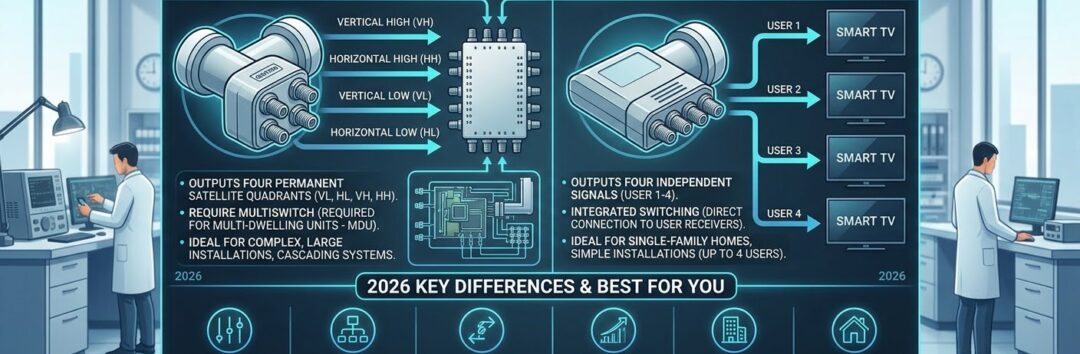
| Quad LNB | Up to four directly connected tuners | Each output behaves as an independent full-band receiver output |
| Quattro LNB | Professional SMATV systems with a multiswitch | Four fixed outputs: VL / VH / HL / HH |
The most important distinction is that Quad is not interchangeable with Quattro in a conventional professional multiswitch installation. For a detailed comparison, see Quattro vs Quad LNB.
What Does the LNB Frequency Setting Mean?
Most modern home satellite installations use a Universal LNB with typical local oscillator (LO) settings of 9750 / 10600 MHz. A 22 kHz control tone is commonly used to switch between low and high bands. Do not change the receiver's LNB frequency setting at random: incorrect settings can make some transponders disappear even when the dish is aligned correctly.
How to Choose the Right LNB
- Identify the system type: One receiver, several independently connected tuners, or an SMATV distribution system.
- Count the outlets: Small homes may use Single, Twin or Quad LNBs. Conventional centralized systems generally use a Quattro LNB feeding a suitable multiswitch.
- Check the satellite and dish: Dish size, location and alignment should be considered before replacing the LNB.
- Choose good-quality coaxial cable: Cable losses can be mistaken for an LNB fault. See our RG6 vs RG11 coaxial cable comparison.
How to Align an LNB Correctly
First adjust the dish for the best signal quality, not just the highest signal-level reading. Then fine-tune the LNB rotation angle (skew). In a central multiswitch system, also verify that all four Quattro outputs are correctly connected to the corresponding VL, VH, HL and HH inputs.
LNBs in SMATV Systems
In apartment buildings and hotels, the LNB is one part of a larger system including the dish, Quattro LNB, multiswitch, coaxial distribution network and TV outlets. For more information, read what an SMATV system is and our step-by-step SMATV network design guide.
Frequently Asked Questions
Does an LNB affect picture quality?
An LNB affects the quality and stability of digital signal reception. If the usable signal falls below the receiver's operating threshold, channels may freeze or disappear.
Can I use a Quad LNB instead of a Quattro LNB?
Not as a general replacement in conventional multiswitch systems. The output behavior is different, so the LNB must match the distribution design and multiswitch requirements.
When should an LNB be replaced?
After ruling out dish alignment, cabling, connectors and receiver settings. Symptoms such as missing complete bands or continued instability may justify testing and replacing the LNB.
AY Technology designs and installs satellite reception and SMATV distribution systems for homes, buildings and larger projects.
WhatsApp +20 155 122 6666Call +20 120 007 7165