AY Technology | Hotel Television Engineering in Egypt
Digital Headend Systems in Egypt: IPTV, DVB-C and SMATV Distribution
Technical guide to digital headend architecture for hotels, resorts, hospitals, residential compounds and large developments. Compare satellite reception, QAM cable TV, managed IP multicast and fiber distribution before specifying equipment.
Hotel IPTV Design & Installation Request a Project Assessment
What Is a Digital Headend?
A digital headend is a centralized system that receives channel sources, processes or remultiplexes signals as supported by the selected hardware, and delivers them to a building’s television distribution infrastructure. Its purpose is to give engineering teams centralized control of channel plans, source reception and downstream distribution.
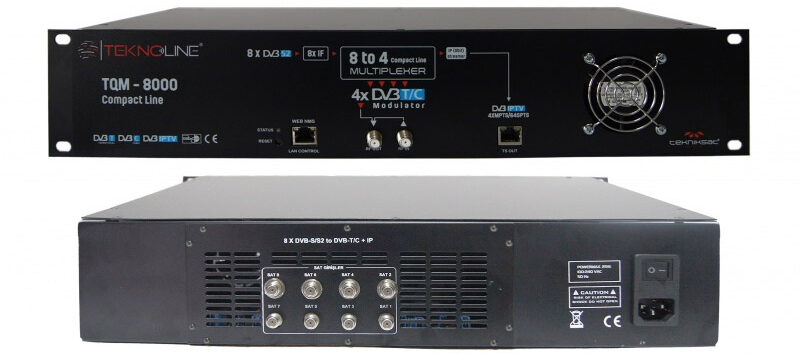
Possible inputs include suitable DVB-S/S2 satellite transponders, other permitted RF feeds and supported IP streams. Common outputs include DVB-C QAM, DVB-T/T2 and IP multicast. These are different standards: compatibility must be verified for every headend module, television tuner or IPTV client.
Which Television Distribution Architecture Fits Your Property?
DVB-C / Digital CATV
Distributes a centrally selected channel lineup over suitable coaxial cabling. Requires compatible DVB-C tuners and a tested RF signal plan. Often worth evaluating for existing hotels with a serviceable coax network.
DVB-T / DVB-T2
Uses terrestrial digital modulation for compatible receiving tuners. Do not assume an RF connector on a TV guarantees support for the specific DVB standard or modulation format.
DVB-S/S2 to IP
A suitable gateway can convert received live TV channels into IP multicast streams for distribution over an engineered managed LAN. This is distinct from interactive guest-service middleware.
Hospitality IPTV
An interactive platform may provide welcome screens, hotel information and guest functions. PMS integration requires verified compatible middleware, APIs, television models and versions.
Hybrid RF and IP architectures can preserve usable coaxial cabling while introducing additional TV or guest services. See the SMATV vs MATV vs IPTV comparison.
Headend Engineering: Source Capacity, Channel Plan and Network
A headend bill of quantities must be based on channel requirements, source transponders, permitted content access, television compatibility and distribution topology—not just a headline figure such as “80 channels.” Satellite transponder capacity and output multiplex requirements can differ substantially between projects.
- Reception: dish alignment, Quattro LNB feeds and input signal measurements where relevant.
- Signal processing: selected receiver/gateway modules, channel remultiplexing and output modulation supported by the actual device.
- RF distribution: frequency planning, QAM/DVB-T levels, cable attenuation, taps, splitters and amplifiers based on measurements.
- IP distribution: multicast group management, IGMP Snooping/Querier, separate IPTV VLANs, switching uplink capacity and monitoring.
- Fiber backbone: ODF, termination, link tests and equipment-room distribution for multi-building hotels and resorts.
Channel encryption, CAM modules, subscription rights and public/hospitality viewing authorization must be reviewed against the relevant content provider’s terms.
From Site Survey to Commissioning
- Collect the room and television inventory, headend location, existing cabling and desired channel lineup.
- Choose the appropriate DVB-C, DVB-T/T2, SMATV, IPTV or hybrid architecture.
- Prepare the signal-flow diagram, bill of quantities, channel plan, headend and network requirements.
- Install and configure the distribution hardware according to manufacturer specifications and actual measured signal levels.
- Test representative rooms simultaneously, monitor channel changes and multicast performance, verify power recovery and document the handover.
Digital Headend Questions
Can a hotel use existing coax cable for Digital TV?
Potentially, after verifying the cable network’s condition, loss levels, splitters, available frequencies and the televisions’ supported tuners.
Does IPTV require internet service for every live TV stream?
Local live channel delivery may use multicast over the hotel LAN from an appropriate headend. External OTT apps and online services have different internet requirements.
Can an IPTV platform integrate with OPERA PMS?
Only if the chosen hospitality TV platform and its middleware support the required integration interfaces and versions. Confirm this before final equipment selection.
How do you determine the number of headend modules?
Calculate from the channel sources, transponder inputs, modulation outputs, licensed content handling and hardware capacity, with an allowance for future changes.
Request a Hotel IPTV or Digital Headend Engineering Proposal
Send the property location, room/TV count, screen models, existing coax or LAN/fiber design, channel sources and the guest experience you need. AY Technology can assess the architecture, equipment scope, installation and acceptance tests.
Hotel IPTV Solutions · Digital Headend Technical Guide · Request an Assessment · WhatsApp