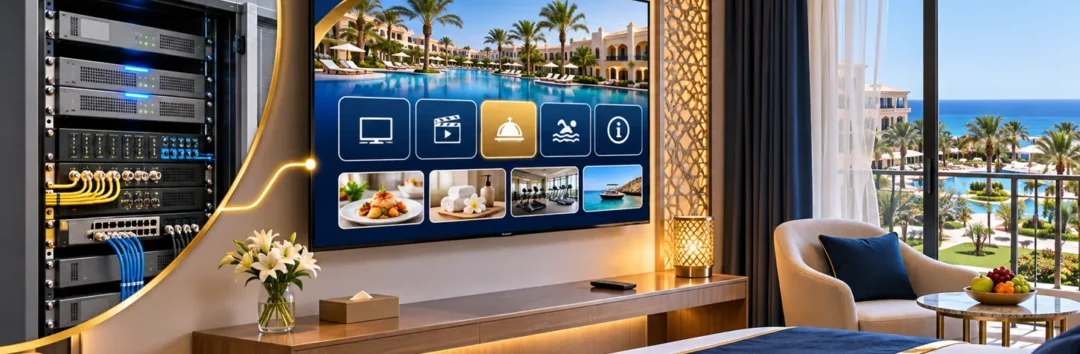
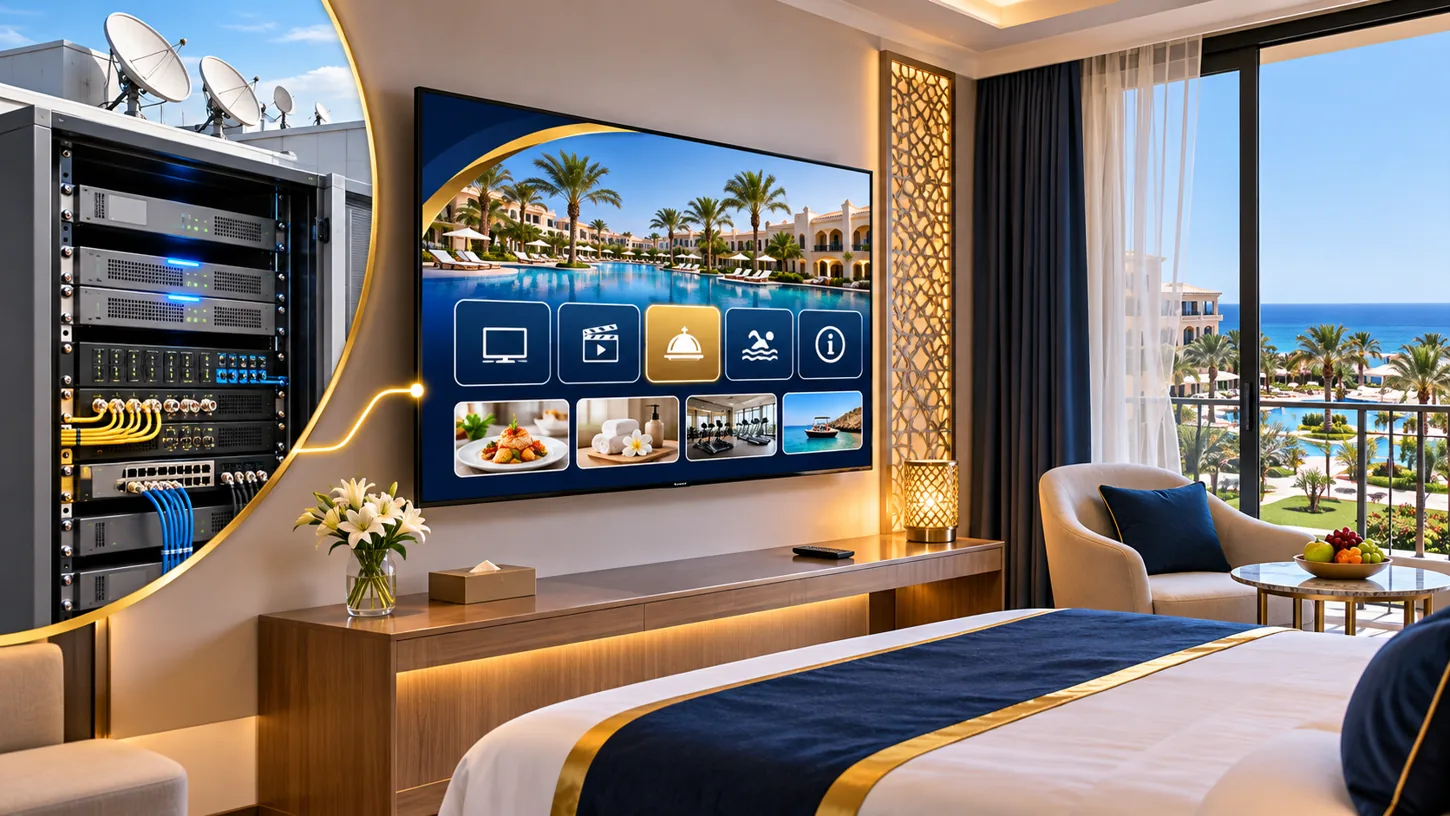
تحديث أنظمة تلفزيون الفنادق • حلول فنية للمشروعات القائمة
Modernizing Hotel and Resort TV Without Replacing the Entire Infrastructure: SMATV, Digital TV, IPTV and Guest Information Channels
دليل عملي لصاحب الفندق والمهندس: إمتى نحتفظ بكابلات الكوكسيل؟ وإمتى نحتاج شبكة IP؟ وإزاي نضيف قناة معلومات أو شاشة ترحيب للنزيل من غير ما نشتري منظومة غير مناسبة للمبنى؟
تطوير تلفزيون الفندق يبدأ من مشكلة التشغيل، مش من شراء محطة جديدة
في فنادق وقرى سياحية كثيرة، شاشات الغرف تعمل بالفعل على كابلات كوكسيل Coaxial/RG6 قديمة نسبيًا. المشكلة قد تكون عدد قنوات محدود، جودة غير مستقرة، اختلاف ترتيب القنوات بين الغرف، أو عدم وجود قناة تعريفية خاصة بالفندق. بعض الملاك يسمع نصيحة: «لازم تشيل الدش المركزي وتعمل IPTV»، لكن تغيير بنية فندق شغال قد يعني تكسيرًا وتعطيل غرف وتكلفة لا يبررها المطلوب.
السؤال الأول الصحيح: هل المطلوب تطوير القنوات وإضافة محتوى الفندق فقط، أم واجهة تفاعلية لكل غرفة وربطها ببيانات النزيل؟ الإجابة هي التي تحدد البنية المناسبة. دليل IPTV للفنادق يشرح النظام الكامل، أما هذا الموضوع فيركز على قرار تحديث فندق قائم وتقليل الأعمال الإنشائية غير اللازمة.
صاحب الفندق عايز إيه؟ وماذا يحتاج مدير الـIT والمهندس؟
صاحب الفندق أو المنتجع
مدير التشغيل والاستقبال
المهندس الاستشاري / مدير IT
الفندق الجديد يختلف عن فندق يعمل منذ سنوات؛ وكذلك المبنى الواحد يختلف عن منتجع يضم شاليهات ومناطق متباعدة. لا توجد محطة واحدة مناسبة لكل السيناريوهات.
الفرق الحقيقي بين الدش المركزي وDigital TV وHospitality IPTV
| the system | مسار الإشارة | ماذا يقدّم؟ | حدوده الرئيسية |
|---|---|---|---|
| SMATV / MATV | أقمار/هوائي + Headend أو Multiswitch + Coax | استقبال وتوزيع مركزي للقنوات إلى الشاشات | الإمكانات التفاعلية ليست جزءًا مضمونًا من توزيع RF |
| Digital TV – DVB-T / DVB-C | Headend/Modulator → RF Coax → TV Tuner | قنوات رقمية وقناة معلومات داخلية مع إعادة استخدام كوكسيل صالح | يجب توافق تيونر الشاشات وخطة الترددات ومستويات الإشارة |
| IPTV / Multicast | Headend / IP Gateway → LAN/Fiber → TV أو STB | Live TV وإدارة أوسع للواجهة والمحتوى حسب المنصة | يتطلب شبكة مُدارة وسعات وفصلًا مناسبًا وتهيئة أجهزة الاستقبال |
| Hospitality TV + Middleware | IPTV أو منصة شاشة فندقية مع طبقة تطبيق | ترحيب حسب الغرفة، قوائم تفاعلية، رسائل وخدمات عند الدعم | التوافق مع الشاشات وPMS/API وترخيص المنصة شرط أساسي |
| Hybrid | Coax في مبانٍ + IP في مناطق أو غرف أخرى | تحديث تدريجي يتجنب تغيير كل المسارات مرة واحدة | يلزم توحيد مصادر المحتوى واختبار تجربة النزيل بين المناطق |
مصطلح Local TV قد يُقصد به القنوات الأرضية المحلية، وقد يُقصد به قناة داخلية خاصة بالفندق (In-house / Hotel Information Channel). يجب تحديد المقصود في الـBOQ حتى لا يتم توريد النظام الخطأ.
ثلاثة حلول معمارية حسب حالة الفندق
1) الفندق القائم: إعادة استخدام الكوكسيل مع Digital TV
لو مسارات الكوكسيل والتجميعات سليمة، يمكن استقبال القنوات في المحطة المركزية، ثم توزيعها كقنوات رقمية DVB-C أو DVB-T وفق تيونر الشاشات وحالة الشبكة، وإضافة قناة معلومات من Media Player أو CMS عبر HDMI Encoder/Modulator. قد يحتاج التنفيذ تغيير موزعات أو مضخمات أو إصلاح أجزاء من الكابلات بعد المسح؛ «من غير تغيير البنية» لا يعني «من غير فحصها».
2) مشروع جديد أو شبكة IP جاهزة: Hospitality IPTV
عندما تكون شبكة LAN مناسبة، يتاح بث القنوات عبر IP Multicast وإضافة خدمات فندقية حسب المنصة والشاشة: قناة المعلومات، واجهة الخدمات، وطلبات النزيل وربط PMS عند توفر تكامل رسمي. لا تعني كلمة IPTV تلقائيًا أن الشاشة تدعم كل الخصائص؛ بعض الحلول Live TV فقط أو Serverless.
3) منتجع متفرق المباني: Hybrid RF + IP
في المنتجعات يمكن توزيع الإشارة بين المباني عبر Fiber Backbone ثم استخدام Coax/Digital TV داخل مبانٍ قائمة، مع IP في مبنى جديد أو الاستقبال أو الأجنحة. اختيار Optical RF أو IP عبر الفايبر يتحدد حسب المسافات، الأجهزة، البنية والفقد والقدرات التشغيلية.
قناة معلومات الفندق: الحل الذكي الذي لا يشترط IPTV كاملًا
قناة الفندق أو Hotel Information Channel / In-house TV Channel عبارة عن قناة داخلية تحمل محتوى المنشأة: مواعيد الوجبات، الأنشطة، خريطة المنتجع، أرقام الخدمات، إجراءات السلامة، عروض المطاعم والسبا، ومعلومات الوصول إلى الاستقبال. يمكن إنتاجها من Digital Signage Player أو Content Management System (CMS)، ثم بثها كقناة رقمية عامة عبر Modulator إلى شبكة الكوكسيل أو كـIP Stream إلى الشاشات.
قناة معلومات مشتركة
شاشات استقبال ولوبي
مصادر HDMI وLocal TV
مهم: قناة المعلومات المشتركة لا تعرف اسم النزيل أو رقم الغرفة بنفسها؛ هي بث واحد لجميع الشاشات، إلا إذا أضيفت بنية تفاعلية منفصلة.
شاشة الترحيب Welcome Screen وربط نظام إدارة الفندق PMS
«عايز التلفزيون يقول: أهلاً أستاذ أحمد في غرفة 205» — ده طلب مختلف عن تشغيل قناة معلومات عامة. الترحيب المخصص يحتاج Guest-Room Identity، وواجهة تسمح بعرض محتوى مختلف حسب الغرفة مثل Hospitality TV App أو Set-Top Box أو منصة شاشة فندقية متوافقة، مع Middleware يدير البيانات والصلاحيات.
PMS = Property Management System، أي برنامج إدارة الفندق والحجوزات. بعض العملاء يسمونه بالخطأ PMC؛ لذلك نثبت اسم البرنامج ومنتجه والإصدار وواجهة الربط. أمثلة الوظائف الممكنة، حسب النظام والتراخيص: Check-in/Check-out، ربط Room Number، Guest Name أو Language، وإزالة البيانات الشخصية بعد المغادرة. التكامل لا يتم بضغطة زر؛ يحتاج API/Interface معتمدًا، وصلاحيات آمنة وموافقة الفندق على مشاركة أقل قدر لازم من بيانات النزيل.
| الوظيفة | قناة Digital TV عامة | Hospitality TV مع تكامل مدعوم |
|---|---|---|
| قائمة القنوات والتلفزيون المباشر | نعم، عند توافق RF/Tuner | نعم، حسب البنية والـTV/STB |
| مواعيد الإفطار والخدمات العامة | نعم، عبر قناة معلومات واحدة | نعم، داخل تطبيق أو قناة |
| اسم نزيل مختلف في كل غرفة | لا، ليس عبر قناة مشتركة واحدة | ممكن عند دعم الهوية والتكامل |
| رسائل حسب الغرفة أو اللغة | غير متاح عبر RF المشترك وحده | ممكن حسب المنصة وPMS |
| Checkout ومسح بيانات النزيل | لا توجد بيانات نزيل في القناة العامة | يُصمم كشرط اختبار للأمان والخصوصية |
مكونات نظام تلفزيون الفندق — وظيفة كل قطعة
Digital Headend
Encoder / Modulator
SMATV RF Distribution
Fiber Backbone
Managed Network
Hospitality TV / STB
Middleware / CMS
UPS ومراقبة النظام
عدد الـTransponders أو مداخل Headend ليس مساويًا لعدد القنوات. كما أن عدد شاشات الفندق لا يحدد وحده عدد مخارج المحطة؛ الحساب يعتمد على معدل النقل والـServices والـMultiplex والـRF/IP Design وقدرات الموديل وحقوق التشفير.
إيه اللي لازم المهندس يصوره ويقيسه قبل ما يطلب عرض سعر؟
عشان نحكم هل الكوكسيل الحالي يصلح، نحتاج Site Survey حقيقي. إرسال صور لوحة واحدة من غير موديلات أو قياسات لا يكفي لاعتماد نظام جديد.
- حصر الغرف والشاشات: عدد الغرف بكل مبنى، موديل كل Hospitality/Smart/Ordinary TV أو عينة ممثلة، نوع التيونر، منافذ RJ45/Coax، وبرمجياتها.
- صور Headend Rack: الأجهزة من الأمام والخلف، موديلات Input/Output، منافذ HDMI/IP/RF، المحطة القديمة والـUPS.
- صور تجميعات الغرف: Taps، Splitters، Amplifiers، موزعات الطوابق، أسماء الموديلات، التغذية الكهربائية، وجداول Loss إن وجدت.
- قياسات RF: Signal Level وMER وBER والترددات عند المحطة وأول/آخر غرفة ومسار مشكوك فيه، مع التحقق من التداخل ونطاق المرور.
- مسارات الكابلات: As-built Coax/RG6/RG11، عدد المسارات، طولها، إمكانية إضافة Cat6 أو Fiber في مناطق محددة من غير تكسير شامل.
- شبكات IP: Managed Switches، عدد المنافذ، سرعات الرفع، Fiber Backbone، VLANs، IGMP ونقاط ازدحام الشبكة، وليس مجرد «الإنترنت سريع».
- المحتوى: قائمة القنوات واللغات، القنوات المشفرة وحقوق عرضها التجاري، مصدر قناة المعلومات، وهل تحتاج ترجمة/ترجمة مصاحبة/EPG.
- التكامل والعمليات: اسم برنامج PMS وإصداره وواجهاته، عدد موظفي المحتوى، سياسة الخصوصية، وتواريخ العمل المسموح بها دون إخراج غرف من الخدمة.
كيف نحول المعاينة إلى Design وBOQ قابل للتنفيذ؟
- Functional Brief: ما هي القنوات العامة، قناة الفندق، شاشة الترحيب، اللغات، الخدمات التفاعلية والموعد المستهدف؟
- Existing Conditions: مراجعة صور وخرائط البنية وتوزيعات المباني، وتجربة الغرف والقياسات الحقيقية.
- Options Study: مقارنة Coax Digital TV، IPTV، وHybrid على أساس توافق الشاشات، التكاليف والمخاطر وخدمة ما بعد البيع.
- Engineering Design: RF Channel Plan أو IP Multicast Plan، Rack Elevation، Signal Flow، Port Schedule، Backbone وUPS.
- BOQ & Scope: تقسيم توريد الأجهزة، التركيب، البرمجة، رخص CMS/PMS، أعمال الكابلات، الاختبارات، والتدريب، مع حدود المسؤولية.
- Pilot Rooms: تشغيل نموذج في غرف ممثلة من أبعد نقاط الشبكة قبل التعميم، مع قبول الفندق للشكل والوظائف.
- Handover: نتائج قياسات، As-built، نسخة إعدادات، تعليمات تشغيل، صلاحيات حسابات، خطة صيانة وضمان مكتوب.
اختبارات التسليم: إزاي نعرف إن النظام شغال فعلًا؟
فحص جودة القنوات
قياسات RF أو IP
فحص قناة المعلومات
خصوصية PMS
نكتب Acceptance Criteria رقمية حسب اختيار المصنع والتصميم ومقاييس الموقع؛ لا نعد بجودة أو سعة ثابتة لكل فندق من غير بيانات وأجهزة محددة.
مقارنة التكلفة من منظور صاحب المشروع: رأس المال والتشغيل وليس الأجهزة فقط
أرخص محطة في سعر الشراء قد تصبح أغلى بعد إضافة تغيرات الكابلات والشاشات والرخص والصيانة. في المقابل، تجديد شبكة سليمة بالكامل ممكن يكون إنفاقًا بدون فائدة واضحة إذا كان المطلوب فقط تحديث القنوات وقناة عامة.
| عنصر القرار | Digital TV على Coax صالح | Hospitality IPTV | Hybrid مرحلي |
|---|---|---|---|
| تغيير مسارات الغرف | قد يكون محدودًا | قد يتطلب Cat6/IP أو STB للشاشات | حسب كل مبنى |
| قناة معلومات عامة | ممكنة | ممكنة | ممكنة |
| شاشة ترحيب شخصية | ليست ميزة RF عامة | ممكنة بتوافق المنصة | تقتصر على المناطق المدعومة |
| تراخيص وتكامل PMS | غالبًا غير مطلوب للقناة العامة | بحسب منصة Middleware | بحسب الجزء التفاعلي |
| مخاطر التنفيذ داخل فندق عامل | غالبًا أقل بعد نجاح المعاينة | تُراجع حسب الأعمال المدنية/الشبكة | توزع على مراحل |
| معيار الاختيار | سلامة RF + توافق التلفزيونات | شبكة IP + وظائف تفاعلية | فرق المتطلبات بين المباني |
يُفضّل طلب عرضين أو ثلاثة بالمخرجات نفسها لا مقارنة أجهزة مختلفة بأسماء مختلفة، مع بند واضح لأعمال الفندق ولأعمال المقاول وللبرمجة عن بُعد والصيانة والتراخيص.
أسئلة حقيقية بالعربي والإنجليزي — من صاحب الفندق والمهندس
عندي فندق شغال وكابلات دش قديمة، ينفع أضيف قناة معلومات من غير تكسير؟
ممكن إذا كانت شبكة Coax والـAmplifiers/Splitters صالحة وتدعم الترددات المطلوبة، والشاشات مزودة بتيونر مناسب. تُضاف القناة من Media Player/Encoder/Modulator ويُختبر وصولها لكل المناطق قبل اعتماد الحل.
هل شاشة الترحيب باسم النزيل ممكنة من نفس قناة الدش المركزي؟
ليس عبر قناة RF مشتركة واحدة لكل الغرف؛ الترحيب المخصص يتطلب منصة وشاشة/جهاز يدعم تعريف الغرفة وإرسال بيانات مناسبة من PMS بشكل آمن.
الفرق بين IPTV وDigital TV والـSMATV إيه ببساطة؟
Digital TV يرسل قنوات رقمية إلى تيونر الشاشة عبر Coax. SMATV يعبر عن الاستقبال والتوزيع المركزي، وقد يشمل تصميمات متعددة. IPTV ينقل القنوات عبر شبكة IP ويمكن دمجه بخدمات تفاعلية حسب النظام.
هل IPTV لازم إنترنت سريع لكل غرفة؟
ليس بالضرورة؛ بث القنوات داخل الفندق يمكن أن يعمل على شبكة LAN محلية مستقلة أو VLAN مخصصة. سرعة الإنترنت الخارجي تتحدد فقط بالمصادر والخدمات التي تحتاجه، بينما تصميم Multicast والشبكة الداخلية أساسي.
هل شاشة سمارت عادية تنفع بدل Hospitality TV؟
قد تصلح لاستقبال قنوات رقمية أو تطبيق محدد، لكن لا يجوز افتراض توافقها مع شاشة ترحيب مخصصة، قفل الإعدادات، إدارة جماعية أو PMS؛ يجب اختبار الموديل والـFirmware.
يعني إيه PMS؟ والـPMC اللي عندنا ينفع يتربط؟
PMS هو نظام إدارة الفندق Property Management System. كلمة PMC غير محددة كمعيار تكامل تلفزيون؛ نحتاج اسم البرنامج الفعلي وواجهته/API وموافقة مزود النظام قبل الوعد بالربط.
محتاج كام تردد أو كم قناة لـ500 أو 1000 شاشة؟
عدد الشاشات وحده لا يحدد عدد الترددات أو مداخل المحطة. يلزم Channel List، الترددات والمصادر، الـServices والـBitrates، والطريقة RF/IP وسعة الشبكة، قبل إعداد BOQ دقيق.
مين يورد، ومين يركّب، ومين يبرمج لو الفندق خارج مصر؟
يُكتب نطاق واضح: توريد فقط، توريد وتركيب، أو برمجة محلية للمحطة ثم تركيب بمعرفة فريق الموقع مع دعم إعدادات عن بُعد، بشرط الاتفاق على الاختبارات والمسؤوليات والوصول الآمن.
ابدأ بدراسة فنية بدل شراء جهاز قبل المعاينة
لو بتدير فندق أو منتجع أو قرية سياحية وعايز «تظبط قنوات التلفزيون في كل الأوض» أو تضيف Local TV / قناة معلومات الفندق أو تطور نظام الدش المركزي إلى Digital TV أو IPTV، فإن القرار الأول هو حصر البنية الموجودة ومتطلبات التشغيل بدقة.
اطّلع على خدمات Hospitality IPTVandحلول الدش المركزيandدليل المقارنة الهندسية بين الأنظمة. وبعدها قدّم بيانات مشروعك لنحدد جدوى الاحتفاظ بالكوكسيل أو الحاجة للـIP أو حل هجين.
محتاج تطور تلفزيون فندق أو منتجع؟
ابعت عدد الغرف، موديلات الشاشات، صور محطات البث وموزعات الكوكسيل، ومتطلبات قناة المعلومات أو الربط مع PMS؛ ونحدد بعد المعاينة نطاق الدراسة والبدائل المناسبة.
Hospitality TV retrofit • Existing hotels & resorts
Hotel TV Modernization: Reuse Existing Coax for Digital TV, Add an Information Channel, or Upgrade to IPTV
A decision guide for hotel owners, consultants and IT engineers: survey the existing RF plant, choose DVB-C/T or multicast IPTV, design a hotel information channel and scope guest-specific welcome screens correctly.
An operating hotel is not a blank-sheet installation
An existing hotel may already have hundreds of television outlets connected to a working coaxial RF network. Management wants better channel quality, consistent channel lists, a hotel information channel and perhaps interactive guest services. Yet replacing a serviceable coax plant with Cat6 throughout an occupied resort can cause disruption and civil-work costs that outweigh the functional gains.
Define the outcome before selecting an appliance: do you need shared linear channels and an in-house information channel, or a personalized in-room experience tied to a reservation? The answer drives DVB-C/T versus IPTV and determines where hospitality middleware genuinely adds value. See our hotel IPTV engineering overview for the broader solution context.
Different stakeholders, different acceptance criteria
Hotel owner or asset manager
Operations and front desk
Consultant / IT / ELV engineer
A new-build resort, a single-tower city hotel, and a spread-out village with multiple accommodation blocks rarely justify an identical distribution architecture.
SMATV, DVB-C/T, IPTV and hospitality middleware are not interchangeable
| Technology | Signal path | What it enables | Critical constraint |
|---|---|---|---|
| SMATV / MATV | Central reception, RF processing / multiswitch and coax | Centralized linear television distribution | Interactivity is not an inherent property of RF distribution |
| DVB-C / DVB-T Digital TV | Headend/modulator → RF over coax → compatible tuner | Digital channels and a shared in-house information channel | Tuner standard, RF levels, channel plan and plant quality |
| Multicast IPTV | IP headend → managed LAN/fiber → TV or STB | Linear TV over IP with extensible endpoint features | Multicast control, switching, endpoint compatibility |
| Hospitality middleware | Room-aware application/platform above the video layer | Per-room welcome and guest services when supported | Device, software, API, licensing and PMS compatibility |
| Hybrid RF + IP | RF in selected blocks; IP elsewhere | Phased upgrade with a mixed estate | Consistent user experience and proper operational handover |
Terminology note: “Local TV” can mean local terrestrial broadcast channels or an internally produced in-house hotel channel. These are different sources, rights and equipment requirements in the bill of quantities.
Three deployment architectures for hotel retrofits
1. Reuse coax with a DVB-C or DVB-T digital headend
When the existing coaxial infrastructure is healthy, a compatible digital modulator/headend can supply a controlled channel lineup and add an information feed from an HDMI media player or CMS. Verify RF spectrum, tap/splitter frequency range, MER/BER, signal levels and available TV tuner modes first. Some amplifiers and splitters will still need replacement; reusing the cable does not mean accepting every legacy component.
2. Full or selective hospitality IPTV over managed IP
An IP-ready property can use UDP/RTP multicast for live channels and, subject to endpoint and platform support, a guest-services interface. The live TV function may be available without advanced middleware; individualized services generally require a room-aware platform. Managed switches with correct IGMP snooping, querier and multicast routing are essential; internet access alone is not a network design.
3. Hybrid IPTV + DVB-C for multi-building resorts
A resort may retain coax in renovated-but-occupied blocks while deploying IP and interactive TVs in a new wing. A fiber backbone may carry Ethernet/IP or RF optical distribution, but these are different designs and conversion devices. Plan channel numbering, service monitoring, operational responsibility and guest-facing consistency across both sides.
In-house hotel information channels without a full IPTV replacement
An in-house hotel information channel, also searched as hotel TV info channel, guest information TV, internal hotel channel, local TV channel or hotel TV channel, can display restaurant hours, daily activities, resort maps, spa offers, emergency guidance and front-desk contacts. A signage player or CMS renders the content. An encoder/modulator turns the output into a compatible DVB-C/T RF channel; alternatively, an IPTV server can distribute it as an IP stream.
Shared in-room information
Lobby and venue signage
Off-air and internal video feeds
A shared RF information channel has no inherent knowledge of the individual guest or room. Personalized greetings require a separate endpoint/app and secure data integration.
Personalized welcome screens and Property Management System integration
A “Welcome, Ms Smith — Room 205” screen is fundamentally different from a general channel. Per-room personalization requires room identity at the television, compatible hospitality firmware/app or STB, a supporting middleware layer and a permitted data interface from the hotel Property Management System (PMS).
Scope possible events rather than assume universal support: check-in, check-out, room assignment, preferred language, guest display name and guest-message delivery. Depending on the PMS and interface provider, capabilities may be exposed through certified partner interfaces or authorized APIs. Hotel permission, least-privilege access, minimal data storage, encryption and checkout-time erasure belong in the specification.
About “PMC”: PMS is the established term for hotel property management software; “PMC” is not a universal synonym for the interface. If the hotel uses a product called PMC, confirm its vendor, version and supported interface before describing it as integrated.
| Guest-facing capability | One shared DVB-C/T channel | Compatible hospitality platform |
|---|---|---|
| Linear live TV | Yes, if tuners and RF design match | Yes, per the chosen TV/STB |
| General information channel | Yes | Yes |
| Individual guest name per room | No, not via one common RF channel | Potentially, with room identity + PMS integration |
| Room-specific messages/language | Not through shared RF alone | Depending on platform/API |
| Checkout data clearance | No individual guest data in basic RF feed | Security/acceptance requirement |
Hotel TV system components: what each item does
Headend / Gateway
HDMI encoder + RF modulator
RF Distribution Network
Fiber Distribution
Managed IP Switching
Hospitality TVs and STBs
Middleware / CMS
UPS, grounding and handover
Do not equate transponder count with channel count, or TV quantity with headend input count. Actual sizing requires the channel list, service bitrates, mux architecture, simultaneous network loads, receiver support and content/access rights.
Pre-quotation survey: the photos and measurements engineers need
A photograph of one rack is not enough to approve a retrofit design. Request a site inventory, sample endpoints and representative signal tests before a bill of quantities.
- Room and display inventory: rooms by block, TV manufacturer/model/firmware, DVB-C/T compatibility, available RJ45/coax/HDMI ports and hospitality-mode capabilities.
- Headend and rack photographs: front and rear labels, input/output modules, HDMI/IP/RF ports, amplifiers, power systems and patching.
- Floor collection points: close-ups of taps, splitters, line amplifiers, model numbers, gain/loss markings, power supplies and terminations.
- RF survey: channel spectrum, levels, MER/BER at the headend and a representative near/far room sample; identify ingress and unbalanced branches.
- Physical pathways: coax topology, cable types/lengths, available risers and feasibility of selective Cat6 or fiber additions.
- IP network: managed-switch models, fiber uplinks, port utilization, VLANs, multicast/IGMP capability and areas of congestion.
- Content and rights: channel lineup, encrypted services, commercial public-performance rights, audio/subtitle needs and information-source workflow.
- PMS and hotel operations: actual software name/version and authorized API, change windows, privacy policy, content administrator and access constraints.
Turning the survey into a scoped design and BOQ
- Requirements workshop: guest-room UX, channel sources, information feeds, personalized functions, room numbers and languages.
- Existing-state baseline: measured RF/IP performance, equipment inventory, rack layouts and a representative endpoint sample.
- Options analysis: compare digital RF, IPTV and hybrid approaches with transparent constraints and lifecycle costs.
- Design package: block/signal-flow diagram, RF channel plan or multicast plan, rack elevations, VLANs, fiber schedule and power needs.
- Bill of quantities: supply, installation, programming, licensing, PMS interface, civil work, testing, training, warranty and support boundaries.
- Pilot rooms: validate reception quality, remote-control UX and information content in selected near/far locations before broad rollout.
- Handover: as-builts, accepted test records, admin credentials under hotel ownership, backups and support/escalation procedures.
Commissioning tests before the project is accepted
Live channel verification
RF/IP performance
CMS information updates
PMS privacy and reset
Numerical acceptance limits must follow the chosen standards, manufacturers, design margins and site requirements; no universal quality or capacity guarantee can be inferred from an article.
Choose on lifecycle value, not headend sticker price
Comparing equipment quotes without rewiring scope, television compatibility, middleware subscriptions and support responsibilities can hide the real project cost. Equally, replacing a functional coax estate solely to show a general hotel information channel may offer little operational return.
| Decision factor | Digital TV over verified coax | Hospitality IPTV | Phased hybrid |
|---|---|---|---|
| Room rewiring | Often limited, after survey | May require network remediation/compatible STBs | Selective per block |
| Shared hotel information channel | Supported via modulator/CMS | Supported via IPTV/CMS | Supported across planned domains |
| Personalized welcome screen | Not from a common RF channel alone | Possible with supported middleware and PMS | Only on compatible endpoints |
| Ongoing platform licensing | Often lower for basic common channel | Vendor- and feature-dependent | Depends on interactive deployment |
| Occupied-hotel disruption | Potentially low after validation | Site/path dependent | Split into manageable phases |
| Primary technical gate | RF integrity + TV tuner | Network control + compatible clients | Integration/operations across both |
Ask bidders to price the same agreed functional specification, and separate supply-only, supply-and-install, commissioning, remote configuration, subscriptions, warranty and maintenance in the commercial offer.
Frequently asked questions: commercial search terms and engineering language
Can we add a hotel information channel using our existing coax?
Often yes, provided a survey verifies RF quality and channel-plan capacity and the televisions decode the chosen DVB-T/C signal. A media player and professional encoder/modulator can deliver one shared feed.
Is IPTV the same as internet TV in hotel rooms?
No. Hotel live IPTV can run over a managed local LAN using multicast. External internet bandwidth is only required for sources and services that use it; network switching and multicast architecture remain essential.
Can an RF information channel say each guest’s name?
Not as one shared broadcast. Room-specific welcome messages require suitable endpoints, room identity, a guest-experience app or middleware and approved PMS integration.
Do we need IPTV set-top boxes with hospitality TVs?
Not universally. It depends on native app support, firmware, content codecs, DRM/conditional access and the selected vendor platform. A controlled compatibility test is mandatory.
What is the difference between Digital Headend, SMATV and DVB-C?
SMATV describes centralized reception/distribution. A digital headend processes services. DVB-C is a cable digital modulation standard that may be used for RF delivery across a compatible coax network.
Can you integrate with OPERA PMS, or our “PMC” software?
Integration is subject to the exact product/version, official interfaces, permission, licensing and middleware features. “PMC” must be clarified as a specific system rather than assumed to be PMS.
How many transponders or channels for a 500- or 1,000-room hotel?
Room count alone is insufficient. Specify input sources, wanted program services, bitrates, multiplexing, output standards and network/headend limits to size the system accurately.
Can the hotel install while you preconfigure the headend or support remotely?
That is one possible scope, provided supply, installation, commissioning, network access, cybersecurity, testing and acceptance responsibilities are written into the contract.
Request a retrofit assessment before selecting the equipment
Whether the search began with hotel TV installation, hotel IPTV Egypt, DVB-C headend for hotels, SMATV upgrade, hotel welcome TV, in-house information channel or resort television distribution, the starting point is the operating building: room inventory, existing wiring, guest-facing requirements and a properly scoped survey.
Explore Hospitality IPTV systems, SMATV and central satellite distribution, and our IPTV versus Digital TV engineering comparison before requesting a site-specific option assessment.
Planning a Hotel TV Upgrade?
Share room counts, television models, headend and distribution photos, and whether you need an in-house information channel or PMS-connected welcome screens. An on-site survey defines the practical options and project scope.