
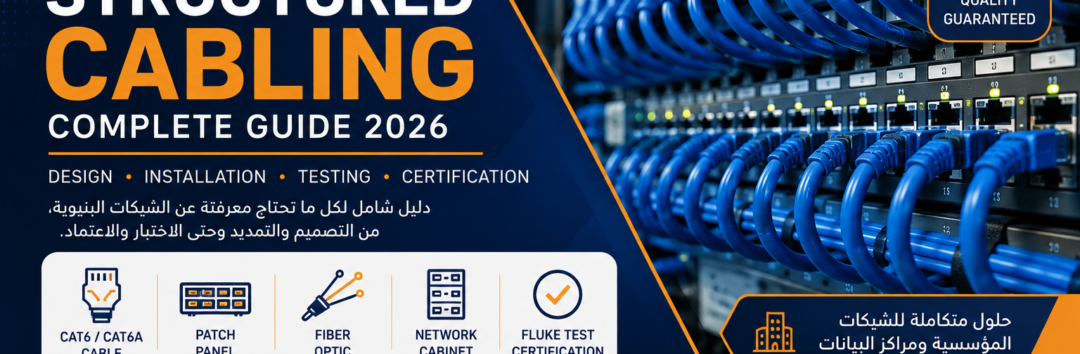
Enterprise Network Infrastructure • Egypt
Structured Cabling Guide: Cat6, Cat6A, Fiber Backbone and Network Infrastructure
Structured cabling provides the organized copper and optical infrastructure behind offices, hotels, hospitals, factories and data centres. A reliable network begins with cable pathways, standards-based design, well-labelled patching and appropriate testing—not simply pulling more Ethernet cables.
Request a Structured Cabling Quotation Explore Enterprise LAN ServicesWhat Is a Structured Cabling System?
Structured cabling is a planned physical connectivity system using standardized components and cable routes to serve data, communications, Wi-Fi, CCTV, IP telephony, building systems and other supported applications. A consistent architecture simplifies network upgrades, troubleshooting and future equipment replacement.
A complete project includes not only copper or optical cables but also cabinets, patch panels, outlets, termination components, pathways, racks, labelling, documentation and tests appropriate to the installed link class.
Principal Components of a Structured Cabling Installation
Horizontal Copper Cabling
Permanent links from a telecommunications room to work-area outlets, using the correct cable category and installation route for the intended applications.
Patch Panels and Data Outlets
Organized terminations and patching in network cabinets and at user locations. Verify compatibility between connectors, jacks, cable and the intended channel category.
Network Cabinets and Racks
Protect and organize switches, patch panels, optical distribution equipment, cable management, PDUs and related components with suitable access and ventilation.
Fiber Optic Backbone
Optical cabling between rooms, risers, buildings and core distribution equipment, with ODF termination, appropriate optical modules and measured links.
Patch Cords and Cable Management
Correctly rated patch cords, horizontal and vertical managers, clear identification and bend-radius management make ongoing operations more reliable.
Network Switches and Uplinks
Suitable managed access, distribution or core switches complete the data infrastructure; active equipment must be specified separately from passive cabling.
Cat6 vs Cat6A: Which Copper Cable Should You Choose?
Cat6 and Cat6A each support common Ethernet applications when installed and certified to the relevant requirements. Cat6A is typically preferred for 10GBASE-T channels up to the standardized 100-metre limit; Cat6 may support 10GBASE-T at shorter lengths depending on conditions, but should not be assumed to provide 100-metre 10G operation.
| Parameter | Cat6 | Cat6A |
|---|---|---|
| Nominal component bandwidth | 250 MHz | 500 MHz |
| Common Ethernet use | 1GBASE-T over standards-compliant channels | 1GBASE-T and 10GBASE-T over suitable channels |
| 10GBASE-T | Distance may be restricted and environment-dependent | Designed for 100-metre channels when correctly installed |
| Physical installation | Usually easier cable handling and termination | Often larger cable diameter and tighter pathway requirements |
| Alien crosstalk considerations | May require assessment for 10G applications | Designed for better alien crosstalk control |
| Typical project decision | Current access networks with suitable expansion plans | New enterprise installations requiring 10G capability or future headroom |
Standards and Installation Architecture
Relevant cabling standards can include the ISO/IEC 11801 and ANSI/TIA-568 families, with additional standards applicable to pathways, administration, grounding and specific facilities. The correct project specification should identify the exact edition and test limits required; a brand name alone does not establish compliance.
- Entrance facilities: Where service-provider links enter the building.
- Equipment room: Space for core/distribution equipment, servers and associated patching where required.
- Telecommunications rooms: Floor or area distribution points serving horizontal cable runs.
- Backbone cabling: Links connecting telecommunications rooms, equipment spaces and facilities.
- Horizontal cabling: Permanent cables connecting the distribution point to work-area outlets.
- Work areas: User outlets, patch cords, IP phones, access points and other endpoints.
Planning Horizontal Links and Cable Pathways
Plan cable routes before ceilings and finishing works are completed. Consider cable tray capacity, risers, separation from sources of interference, firestopping, protection from mechanical damage and the bend-radius and pulling-tension limits of the chosen cables.
In common balanced-twisted-pair designs, a horizontal permanent link is typically limited to 90 metres, with an overall channel length up to 100 metres after allowing suitable equipment and work-area cords. Always confirm the specific standard and product installation rules.
Structured Cabling for Wi-Fi and PoE Devices
Modern access points, IP cameras, telephones and access control endpoints may require Power over Ethernet. Cable selection must therefore account for data rate, installation temperature, cable bundle size, conductor material and resistance, the supported PoE standard and the network switch power budget.
- Use appropriate standards-compliant copper conductors and avoid unsuitable copper-clad aluminium cabling for designed enterprise links.
- Check PoE heating and bundled cable installation conditions, especially with higher-power devices.
- Assess multi-gigabit Wi-Fi access-point uplinks when the active equipment requires them.
- Include additional outlets and spare cabling capacity where future expansion is expected.
Fiber Backbone and Data Centre Connections
Optical fibre can connect telecommunications rooms, building cores, data centres and separate buildings. Select single-mode or multimode fibre to suit distance, transceiver and application requirements. Plan ODFs, patching, splicing, optical loss budgets and testing alongside the physical backbone.
For additional guidance, see the Fiber Optic Network Design Guide.
Network Cabinets, Patch Panels and Documentation
An organized cabinet improves maintenance and allows future upgrades without unnecessary disturbance of existing links. Arrange patch panels and switches with suitable cable management, access for technicians, environmental conditions, grounded equipment where required and clearly labelled ports.
The as-built handover should identify rack locations, panel ports, permanent link identifiers, outlet locations, pathways, test results and any known exceptions.
How to Test and Certify Structured Cabling
Verification depends on the link category, intended application and contract. Proper certification with an appropriate field tester measures applicable parameters—such as wire map, insertion loss, NEXT, return loss and other requirements—for the selected permanent-link or channel test configuration.
Important: Merely connecting a laptop and obtaining a 1 Gbps link does not certify a Cat6 or Cat6A installation. A suitable qualification or certification report should be requested where the project specifies it.
Continuity and Wire Map
Detect incorrect terminations and pair faults; confirm intended pinout and connectivity.
Category Certification
Run the applicable standard and test limit on a compatible certified cable analyzer, retaining result files and test identifiers.
Fibre Optic Acceptance
Perform appropriate optical loss tests and OTDR measurements where specified, documenting route and core identifiers.
As-Built Handover
Provide cabinet elevations, patch schedules, outlet identification, results and agreed support information.
Typical Structured Cabling Project Workflow
- Site survey: Verify buildings, floors, existing pathways, equipment-room locations and required data outlets.
- Design and BOQ: Define cabling categories, fibre cores, racks, patching, cable routes and quantities.
- Coordination: Confirm pathways, penetrations, containment, equipment space and phasing with other construction trades.
- Installation and termination: Pull cables to suitable standards, install cabinets and terminate links with clear labels.
- Certification and commissioning: Record copper and fibre test results, troubleshoot failures and verify relevant active links.
- Documentation and handover: Deliver the agreed drawings, link schedules, certificates and support arrangements.
Common Cabling Mistakes
- Mixing cabling components without checking end-to-end channel category compatibility.
- Exceeding approved cable lengths or bend-radius limits.
- Running cables in unsuitable routes or failing to coordinate with power infrastructure.
- Leaving insufficient cabinet capacity, spare outlets or cable management space.
- Omitting permanent labels, cabinet documentation and certification reports.
- Assuming cable compliance or performance solely from a printed marketing claim.
Frequently Asked Questions
Is Cat6A always necessary for a new office?
Not always. It depends on expected link speeds, applications, budget, PoE use and expansion requirements. Cat6A is worth considering when 10GBASE-T to the specified channel distances or additional headroom is required.
How far can an Ethernet copper cable run?
Many structured balanced-copper channels are designed to a maximum of 100 metres overall, typically with a permanent link up to 90 metres and suitable cords. Exact limitations depend on the standard and application.
Can fibre and copper be used together?
Yes. Copper often serves horizontal data outlets, while fibre provides riser, backbone or inter-building links in the same structured infrastructure.
What is the difference between testing and certification?
Basic connectivity tests verify some simple functions. Cabling certification measures the defined parameters against a selected cable-class/category standard using suitable equipment.
What information is needed for a network cabling quote?
Provide floor plans, outlet counts, cabinet positions, approximate pathways, desired copper category, fibre backbone needs and test/handover requirements.
Planning a Structured Cabling or Data Infrastructure Project in Egypt?
AY Technology can assess your site, design the cable and fibre layout, prepare an equipment BOQ, install and test the infrastructure, and support commissioning for offices, hotels, healthcare facilities and enterprise buildings.
Request a Technical Quotation Enterprise Network Solutions WhatsApp Engineering TeamThe Complete Structured Cabling System Guide Structured Cabling Guide 2026
يعتبر Structured Cabling Structured Cabling is the foundation of any Enterprise Network Infrastructure modern infrastructure, supporting all data, voice, and video transmission systems across companies, factories, hotels, hospitals, and data centers Data Center. Proper design ensures easy maintenance, scalability, and stable network performance for many years.
Whether you are planning a new network or upgrading an existing one, implementing Structured Cabling System to international standards ensures full utilization of Cisco andAruba andHuawei Enterprise andUniFi, while also improving the performance of Access Point andIP Cameras andVoIP andAccess Control and all systems that depend on the network.
What Will You Learn in This Guide?
- ما هو Structured Cabling؟
- Structured Cabling system components.
- Cat6 and Cat6A cable types.
- Patch Panel and Keystone Jack.
- Network Cabinet and Server Rack.
- Fiber Backbone and ODF.
- Fluke Test Certification.
- Best practices for enterprise network implementation.
ما هو Structured Cabling؟
Structured Cabling is a unified system for organizing and routing all network cabling within buildings in an engineered way that ensures easy management, fast maintenance, and scalability without rebuilding the infrastructure with every upgrade.
The system is divided into organized sections using Patch Panel andNetwork Cabinet andPatch Cord andFace Plate andKeystone Jack, while complying with international standards such as ANSI/TIA andISO/IEC.
| العنصر | الوظيفة |
|---|---|
| Cat6 / Cat6A Cable | Data transmission between network devices. |
| Patch Panel | Organizing and consolidating all network points. |
| Keystone Jack | Cable termination at the Face Plate or Patch Panel. |
| Network Cabinet | Housing network equipment and organizing cabling. |
| Server Rack | Hosting servers, storage, and UPS systems. |
Why Do Companies Need Structured Cabling?
Modern companies rely on dozens of systems operating at the same time, such as ERP andIP Telephony andCCTV andAccess Control andTime Attendance andHospitality TV. Random cabling makes maintenance difficult, reduces performance, and increases faults.
A professionally implemented Structured Cabling System provides a professional infrastructure that ensures network stability and makes it easy to add new users or devices while maintaining performance as the organization grows.
- Easy network management.
- Reduced faults.
- Easy maintenance.
- Support for speeds up to 10 Gbps and beyond.
- Ready for future expansion.
- Improved Data Center performance.
- Support for VoIP, IP cameras, and Wi-Fi 6.
- تقليل تكاليف التشغيل والصيانة.
مكونات نظام Structured Cabling
يتكون Structured Cabling System consists of interconnected components that work together to provide a stable, easy-to-manage network. Neglecting any component can reduce network efficiency, increase faults, and make future maintenance more difficult.
| المكون | Function |
|---|---|
| Cat6 Cable | Transfers data at up to 1 Gbps over 100 meters. |
| Cat6A Cable | Supports 10 Gbps with better resistance to interference. |
| Patch Panel | Organizes all network points inside the cabinet. |
| Keystone Jack | Provides professional cable termination. |
| Patch Cord | Connects devices to the Patch Panel. |
| Cable Management | Organizes cabling inside the rack. |
Cat6 vs Cat6A
One of the most common questions during network design is: should I use Cat6 أم Cat6A؟
The decision depends on the current network speed and future expansion plan, so the full project should be assessed before choosing the cable type.
| المقارنة | Cat6 | Cat6A |
|---|---|---|
| السرعة | 1Gbps | 10Gbps |
| التشويش | Good | ممتاز |
| السعر | أقل | أعلى |
| الاستخدام | المكاتب الصغيرة والمتوسطة | Large Enterprises & Data Centers |
Patch Panel
يعتبر Patch Panel is one of the most important parts of a Structured Cabling, where all network cables are terminated and connected to Switches باستخدام Patch Cord.
Using a Patch Panel simplifies maintenance, reduces connection errors, and allows network ports to be reassigned without rerunning cables.
- Easy network management.
- Cable organization.
- Reduced faults.
- Easy addition of new network points.
- Faster maintenance.
Keystone Jack & Face Plate
يتم تركيب Keystone Jack inside Face Plate or inside Patch Panel, which terminates the network cable professionally to ensure connection quality and minimize signal loss.
It is preferable to use components from the same cable manufacturer to achieve the best performance and ensure compatibility across the system.
Cable Management
يعد Cable Management is one of the elements many technicians overlook, even though it plays a major role in organizing cables inside the Network Cabinet andServer Rack, making maintenance easier and preventing cable damage over time.
Do not base your decision only on cable price when implementing a Structured Cabling. Choosing high-quality cabling with genuine Patch Panels and Keystone Jacks and professional installation saves future maintenance and rework costs.
Do you need a Structured Cabling or Enterprise Network Infrastructure project?
توفر AY Technology Design, supply, installation, and testing services for Structured Cabling, Fiber Optic, Data Center, Network Cabinet, Server Rack, GPON, Enterprise WiFi, Access Control, Hospitality TV and complete infrastructure solutions for companies, factories, hotels, and hospitals across Egypt.
🌐 الموقع الإلكتروني:
https://aytechnology.org
Network Cabinet & Server Rack
One of the most common mistakes in Structured Cabling is assuming that Network Cabinet andServer Rack are the same thing, while each has a completely different use within Enterprise Network Infrastructure.
The choice of cabinet or rack depends on project size, number of network points, number of servers, and Switches، وأنظمة UPS, as well as future expansion plans.
| Network Cabinet | Server Rack |
|---|---|
| Patch Panel | Servers |
| Switches | Storage |
| Cable Management | UPS |
| Fiber ODF | PDU |
Fiber Backbone
Every professional project relies on Fiber Backbone to connect floors, buildings, and server rooms at high speeds with full stability, which is why Fiber Optic has become a core standard in modern enterprise projects.
The network backbone is implemented using Single Mode Fiber أو Multi Mode Fiber depending on project requirements, together with ODF andFiber Patch Cord andSFP Module.
Fiber Backbone Components
- Fiber Optic Cable
- ODF
- Fiber Patch Panel
- Fiber Patch Cord
- SFP Module
- Fusion Splicing
- OTDR Test
ODF (Optical Distribution Frame)
is used ODF to organize all Fiber Optic inside Network Cabinet أو Server Rack, while also protecting fiber-optic connections and making maintenance and expansion easier.
Using ODF is one of the key requirements for implementing Data Center andGPON andCampus Network.
Fiber Splicing
After installing Fiber Optic the next step is Fiber Splicing باستخدام أجهزة Fusion Splicer to achieve the lowest possible signal loss and ensure network stability.
| Fusion Splicing | Mechanical Splicing |
|---|---|
| Very low loss | Higher loss |
| High reliability | Medium reliability |
| مناسب للمشاريع الاحترافية | Simple applications |
Best Practices for Structured Cabling Implementation
- Comply with ANSI/TIA and ISO/IEC standards.
- Do not exceed the maximum cable length.
- Label and number all network points.
- Organize cabling using cable management.
- Use a Patch Panel for all network points.
- Separate power cables from data cables.
- Use genuine, certified products.
- Perform a Fluke Test before project handover.
Also Read from AY Technology
Do you need a Structured Cabling project?
توفر AY Technology Design, supply, installation, and testing services for Structured Cabling, Fiber Backbone, Fiber Optic, ODF, Server Rack, Network Cabinet, Data Center and complete infrastructure solutions for companies, hotels, and factories in accordance with international standards.
Fluke Test Certification | Testing and Certification for Structured Cabling Networks
After completing a Structured Cabling the project should not be considered ready for handover until a Fluke Test Certification. This test is the global benchmark for verifying cabling quality and confirming that every network point complies with international standards such as ANSI/TIA-568 andISO/IEC 11801.
Large enterprises, banks, airports, hospitals, and hotels rely on Fluke Test reports to certify network projects before operation because they reveal faults that could affect future network performance.
What Does a Fluke Tester Measure?
- Wire Map
- Cable Length
- Insertion Loss
- Return Loss
- NEXT (Near-End Crosstalk)
- PSNEXT
- Delay
- Propagation Delay
- ACR-F
- Resistance
لماذا يعتبر Fluke Test مهمًا؟
All network points may appear to work normally, but as user count increases or applications such as VoIP andIP Cameras andData Center Applications performance issues can emerge due to hidden cabling or termination faults.
For this reason, Fluke Test Certification helps identify these faults before handover, saving substantial maintenance and repair costs later.
| Without Fluke Test | With Fluke Test |
|---|---|
| أعطال متكررة | Full network certification |
| Difficult fault detection | Detailed reports for every point |
| Higher maintenance costs | Reduced future faults |
| Project remains uncertified | Compliant with international standards |
International Standards for Structured Cabling Implementation
The success of any project depends not only on cable quality but also on compliance with international standards for network design, installation, and testing.
- ANSI/TIA-568 for network cabling design and installation.
- ISO/IEC 11801 for structured cabling systems.
- BICSI Standards for infrastructure project implementation.
- IEEE 802.3 for Ethernet standards.
- IEEE 802.11 for Wi-Fi networks.
Common Mistakes During Structured Cabling Installation
- Using low-quality cables.
- خلط كابلات الكهرباء مع كابلات البيانات.
- عدم استخدام Patch Panel.
- عدم ترقيم نقاط الشبكة.
- عدم استخدام Cable Management.
- ثني كابلات Fiber Optic بطريقة خاطئة.
- عدم إجراء Fluke Test قبل التسليم.
- عدم ترك مساحة للتوسعات المستقبلية.
تكلفة تنفيذ Structured Cabling بطريقة صحيحة أقل بكثير من تكلفة إعادة تنفيذ الشبكة بعد سنوات قليلة. لذلك احرص دائمًا على اختيار منتجات أصلية، وتنفيذ المشروع وفق المعايير العالمية، مع الحصول على تقرير Fluke Test Certification عند الاستلام.
اقرأ أيضًا من مدونة AY Technology
هل تحتاج إلى تنفيذ أو اعتماد مشروع Structured Cabling؟
At AY Technology خدمات تصميم، وتوريد، وتركيب، واختبار واعتماد مشاريع Structured Cabling, Cat6, Cat6A, Fiber Optic, Fiber Backbone, Network Cabinet, Server Rack, Data Center مع تقديم تقارير Fluke Test Certification وفقًا للمعايير العالمية لجميع الشركات والمصانع والفنادق والمستشفيات داخل مصر.
خطوات تنفيذ مشروع Structured Cabling باحترافية
نجاح أي مشروع Structured Cabling لا يعتمد على جودة الكابلات فقط، بل يبدأ من مرحلة دراسة الموقع (Site Survey) مرورًا بالتصميم والتنفيذ والاختبارات وحتى تسليم المشروع للعميل مع جميع المخططات وتقارير Fluke Test Certification.
في AY Technology نتبع منهجية واضحة في جميع مشاريع Enterprise Network Infrastructure لضمان تنفيذ شبكة مستقرة وقابلة للتوسع لسنوات طويلة.
Project Implementation Stages
- Site Survey (المعاينة).
- Network Design.
- إعداد BOQ.
- توريد الخامات.
- تمديد الكابلات.
- تركيب Network Cabinet وServer Rack.
- تركيب Patch Panel وKeystone Jack.
- ترقيم جميع النقاط.
- تنفيذ Fiber Splicing.
- إجراء Fluke Test.
- إعداد As-Built Drawings.
- تسليم المشروع.
1- Site Survey (المعاينة)
تبدأ جميع المشاريع بمعاينة الموقع لتحديد عدد المستخدمين، وعدد نقاط الشبكة، ومسارات الكابلات، ومكان Network Cabinet andServer Rack، بالإضافة إلى تحديد احتياجات Fiber Backbone andWiFi Access Points.
وتعتبر هذه المرحلة من أهم مراحل المشروع لأنها تحدد الميزانية، والجدول الزمني، وطريقة التنفيذ.
2- Network Design
بعد الانتهاء من المعاينة يتم إعداد تصميم الشبكة، ويشمل توزيع نقاط البيانات، ومسارات الكابلات، وأماكن Patch Panel andSwitches andAccess Point، بالإضافة إلى تصميم Fiber Backbone إذا كان المشروع يتطلب الربط بين عدة طوابق أو مبانٍ.
- Network Layout.
- Rack Layout.
- Cable Routing.
- IP Addressing Plan.
- VLAN Design.
- Future Expansion Plan.
3- Bill of Quantities (BOQ)
يتم إعداد BOQ لتحديد جميع المواد المطلوبة للمشروع مثل:
- Cat6 أو Cat6A Cable.
- Patch Panel.
- Keystone Jack.
- Face Plate.
- Patch Cord.
- Cable Manager.
- Network Cabinet.
- Server Rack.
- Fiber Optic Cable.
- ODF.
- SFP Module.
- Managed Switch.
- UPS.
4- Installation
يتم تنفيذ المشروع وفقًا للرسومات الهندسية، مع الالتزام بجميع معايير السلامة، والحفاظ على أقل نصف قطر لانحناء الكابلات، واستخدام وسائل تثبيت احترافية لضمان عمر افتراضي طويل للشبكة.
- عدم شد الكابلات بقوة.
- عدم خلط الكهرباء مع كابلات البيانات.
- ترقيم جميع الكابلات.
- تنظيم الكابلات داخل Rack.
- ترك احتياطي مناسب داخل الكبينة.
- الاعتماد على Cable Management.
5- الاختبارات والتسليم
بعد الانتهاء من التركيب يتم إجراء جميع الاختبارات اللازمة، وعلى رأسها Fluke Test لجميع نقاط الشبكة، بالإضافة إلى اختبار Fiber Optic باستخدام OTDR إذا كان المشروع يحتوي على Fiber Backbone.
ثم يتم تسليم العميل جميع التقارير الفنية، ورسومات As-Built، وقائمة أرقام النقاط، وضمانات المنتجات المستخدمة.
| المرحلة | الناتج |
|---|---|
| Site Survey | تقرير المعاينة |
| Design | رسومات الشبكة |
| BOQ | قائمة المواد |
| Installation | تنفيذ المشروع |
| Testing | Fluke & OTDR Reports |
| Handover | As-Built + Warranty |
اقرأ أيضًا من مدونة AY Technology
ابدأ مشروع Structured Cabling مع AY Technology
إذا كنت تبحث عن شركة متخصصة في تصميم وتنفيذ واعتماد مشاريع Structured Cabling, Cat6, Cat6A, Fiber Optic, Fiber Backbone, Data Center, Network Cabinet, Server Rack وتقديم تقارير Fluke Test، فإن فريق AY Technology يوفر حلولاً احترافية تناسب الشركات، والمصانع، والفنادق، والمستشفيات، والجامعات في جميع أنحاء مصر.
Checklist استلام مشروع Structured Cabling
قبل اعتماد أي مشروع Structured Cabling يجب التأكد من تنفيذ جميع الأعمال طبقًا للمواصفات الفنية، لأن أي خطأ بسيط في مرحلة التنفيذ قد يؤدي إلى أعطال متكررة أو انخفاض أداء الشبكة بعد التشغيل.
قائمة استلام المشروع
- ✅ استخدام كابلات أصلية Cat6 أو Cat6A.
- ✅ جميع الكابلات مرقمة (Cable Labeling).
- ✅ تركيب Patch Panel بطريقة صحيحة.
- ✅ تركيب Keystone Jack بنفس ترتيب الألوان.
- ✅ تنظيم الكابلات داخل Network Cabinet.
- ✅ تركيب Cable Management.
- ✅ اختبار جميع النقاط بواسطة Fluke Test.
- ✅ اختبار Fiber Optic بواسطة OTDR.
- ✅ تسليم As-Built Drawing.
- ✅ تسليم Warranty وشهادات المنتجات.
أكثر الأخطاء التي تؤدي إلى فشل الشبكة
| الخطأ | التأثير |
|---|---|
| عدم إجراء Fluke Test | أعطال غير ظاهرة بعد التشغيل. |
| كابلات غير أصلية | انخفاض السرعة وقصر العمر الافتراضي. |
| عدم استخدام Patch Panel | صعوبة الصيانة. |
| خلط الكهرباء مع البيانات | تشويش وفقد بيانات. |
| عدم ترقيم النقاط | صعوبة إدارة الشبكة. |
Frequently Asked Questions (FAQ)
ما هو أفضل كابل للشركات؟
يعتمد ذلك على طبيعة المشروع، لكن يعتبر Cat6A الخيار الأفضل للمشروعات الجديدة التي تحتاج إلى دعم سرعات 10Gbps والتوسع مستقبلاً.
هل يمكن استخدام Cat6 داخل Data Center؟
يمكن استخدامه في بعض التطبيقات، لكن في أغلب مراكز البيانات الحديثة يفضل استخدام Cat6A أو Fiber Optic لتحقيق أعلى أداء.
ما أهمية Patch Panel؟
يساعد Patch Panel في تنظيم جميع نقاط الشبكة، ويسهل عمليات الصيانة وإضافة المستخدمين الجدد دون الحاجة إلى إعادة تمديد الكابلات.
هل Fluke Test ضروري؟
نعم، يعتبر Fluke Test Certification من أهم مراحل اعتماد مشروع Structured Cabling، لأنه يضمن مطابقة جميع النقاط للمواصفات العالمية.
ما الفرق بين Network Cabinet وServer Rack؟
is used Network Cabinet لتنظيم معدات الشبكات مثل Patch Panel وSwitches، بينما يستخدم Server Rack لاستضافة Servers وStorage وأنظمة UPS.
Conclusion
يعتبر Structured Cabling الاستثمار الحقيقي في أي مشروع شبكات ناجح، فهو الأساس الذي تعتمد عليه جميع الأنظمة الحديثة مثل Enterprise Network Infrastructure، وData Center، وFiber Backbone، وWiFi، وIP Cameras، وAccess Control، وHospitality TV.
اختيار كابلات أصلية، والالتزام بالمعايير العالمية، واستخدام Patch Panel andNetwork Cabinet andServer Rack بالشكل الصحيح، مع إجراء Fluke Test Certification قبل التسليم، يضمن شبكة مستقرة وآمنة وقابلة للتوسع لسنوات طويلة.
مقالات مرتبطة من AY Technology
ابدأ مشروعك مع AY Technology
سواء كنت تحتاج إلى تنفيذ Structured Cabling، أو إنشاء Enterprise Network Infrastructure، أو تصميم Data Center، أو تنفيذ Fiber Optic Backbone، أو تركيب Network Cabinet andServer Rack، فإن فريق AY Technology يقدم حلولاً متكاملة تشمل التصميم، والتوريد، والتركيب، والاختبار، والدعم الفني وفقًا للمعايير العالمية.
نخدم الشركات، والمصانع، والفنادق، والمستشفيات، والجامعات، والجهات الحكومية في جميع أنحاء مصر، مع تقديم تقارير Fluke Test Certification ورسومات As-Built وضمان على جودة التنفيذ.
🌐 https://aytechnology.org
كيفية اختيار نظام Structured Cabling المناسب لمشروعك
يختلف تصميم Structured Cabling System من مشروع إلى آخر، فلا يمكن استخدام نفس التصميم في مصنع، وفندق، ومستشفى، ومركز بيانات Data Center. لذلك يجب دراسة طبيعة النشاط، وعدد المستخدمين، وخطة التوسع المستقبلية قبل اختيار مكونات الشبكة.
| Project type | الحل المناسب |
|---|---|
| المكاتب الإدارية | Cat6 + Network Cabinet |
| Hotels | Cat6A + Fiber Backbone + Hospitality TV |
| Factories | Cat6A + Fiber Optic + Industrial Switches |
| Hospitals | Redundant Fiber + Access Control + Data Center |
| الجامعات | Fiber Backbone + Enterprise WiFi + Aruba أو Cisco |
أفضل الشركات المصنعة لمكونات Structured Cabling
يعتمد نجاح المشروع على جودة المنتجات المستخدمة، لذلك يفضل دائمًا اختيار علامات تجارية معروفة ومعتمدة عالميًا لضمان الأداء والاستقرار على المدى الطويل.
- Osilan Structured Cabling
- CommScope
- Panduit
- Legrand
- Nexans
- Siemon
- Schneider Electric
- Corning Fiber Optic
احصل على استشارة مجانية لمشروعك
إذا كنت تخطط لإنشاء شبكة جديدة أو تطوير البنية التحتية الحالية، فإن فريق AY Technology يساعدك في اختيار أفضل حلول Structured Cabling andFiber Optic andNetwork Cabinet andData Center بما يتناسب مع احتياجات مشروعك وميزانيتك.
لماذا تختار AY Technology لتنفيذ مشاريع Structured Cabling؟
إن نجاح أي مشروع Structured Cabling لا يعتمد فقط على شراء أفضل الكابلات أو أحدث أجهزة الشبكات، بل يعتمد على خبرة الشركة المنفذة في التصميم، والتنفيذ، والاختبار، والتوثيق، وخدمات ما بعد البيع.
في AY Technology نقدم حلولاً متكاملة تبدأ من دراسة المشروع وحتى التسليم النهائي، مع الالتزام بالمعايير العالمية ANSI/TIA andISO/IEC لضمان أعلى مستويات الجودة والاعتمادية.
خدماتنا في مجال البنية التحتية للشبكات
- ✔ Structured Cabling Solutions
- ✔ Enterprise Network Infrastructure
- ✔ Fiber Optic Installation
- ✔ Fiber Backbone Design
- ✔ Fusion Splicing
- ✔ ODF Installation
- ✔ Fluke Test Certification
- ✔ OTDR Testing
- ✔ Network Cabinet Installation
- ✔ Server Rack Installation
- ✔ Data Center Infrastructure
- ✔ Enterprise WiFi Solutions
- ✔ Access Point Deployment
- ✔ GPON Solutions
- ✔ Access Control Systems
- ✔ Time Attendance Systems
- ✔ Hospitality TV Solutions
- ✔ Digital Signage Systems
- ✔ CCTV Surveillance Systems
- ✔ BMS & KNX Smart Building Solutions
المشروعات التي نخدمها
| Project type | الحلول التي نقدمها |
|---|---|
| الشركات الإدارية | LAN - WiFi - Fiber - Server Room |
| Hotels & Resorts | Hospitality TV - GPON - WiFi - CCTV |
| Factories | Industrial Network - Fiber Backbone |
| Hospitals | Data Center - Access Control - Structured Cabling |
| الجامعات والمدارس | Campus Network - Enterprise WiFi |
| shopping malls | Digital Signage - CCTV - Network Infrastructure |
لماذا يثق عملاؤنا في AY Technology؟
- خبرة في تنفيذ مشاريع البنية التحتية للشبكات.
- الالتزام بالمواصفات العالمية.
- تصميم احترافي قبل التنفيذ.
- توريد منتجات أصلية من علامات تجارية معتمدة.
- تقارير Fluke Test وOTDR.
- رسومات As-Built بعد انتهاء المشروع.
- ضمان على جودة التنفيذ.
- دعم فني وخدمات ما بعد البيع.
Also Read from AY Technology
هل تخطط لتنفيذ مشروع Structured Cabling؟
سواء كنت بصدد إنشاء مقر جديد، أو تطوير شبكة قائمة، أو إنشاء Data Center، أو تنفيذ Fiber Optic Backbone، أو تركيب Network Cabinet andServer Rack، فإن فريق AY Technology جاهز لتقديم حلول احترافية تناسب احتياجات مشروعك.
نقدم خدمات التصميم، والتوريد، والتركيب، والاختبارات، والدعم الفني لجميع مشاريع Enterprise Network Infrastructure باستخدام أحدث المعدات وأفضل الممارسات الهندسية.
AY Technology
Integrated Smart Solutions in Communication, Networking & Security